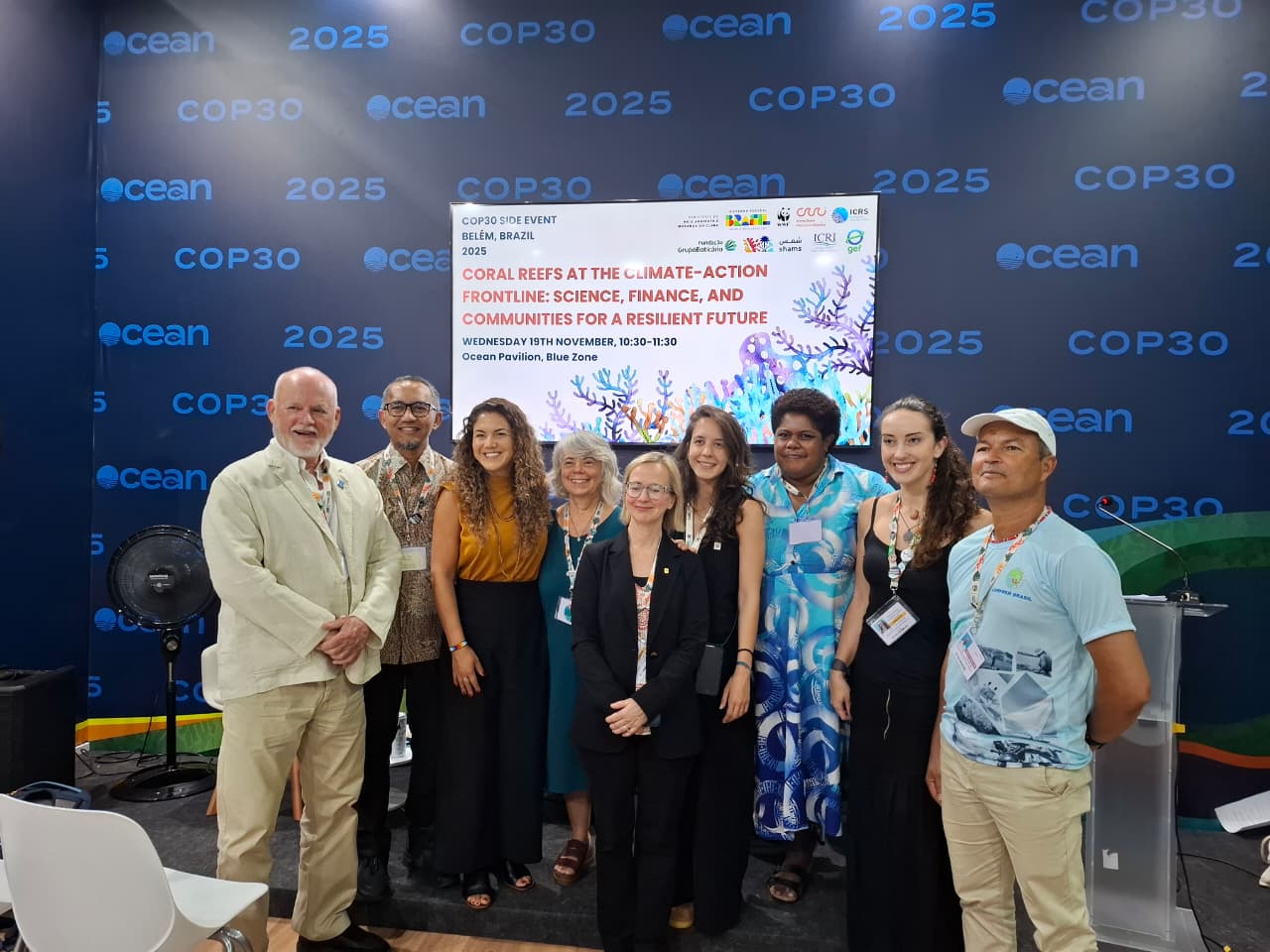
COP30 Side Event | Belém, Brazil | November 19, 2025 | Ocean Pavilion, Blue Zone
The session highlighted coral reefs as vital ecosystems at the forefront of the climate crisis, central to planetary health and the well-being of coastal and Indigenous communities.
Hosted by the Ministry of Environment and Climate Change of Brazil, WWF-Brazil and partners, the event moved beyond dialogue to action. Participants shared practical pathways for accelerating global commitments from COP30 to COP31, focusing on reef-positive finance, inclusive governance, and the integration of scientific innovation with traditional knowledge.
Speakers emphasised that coral reefs are powerful indicators of ocean health, embodying the deep interconnection between climate, nature, and people. Their survival depends on urgent emissions reductions and the rapid scaling of nature-based solutions for adaptation. Locally led, climate-resilient reef economies are essential, and the event underscored how community knowledge and scientific innovation must work hand-in-hand to safeguard these ecosystems.
Countries such as Brazil, Palau, Indonesia and Fiji shared how they are translating ambition into tangible outcomes through innovative financing, restoration science, and community empowerment. The session demonstrated that safeguarding coral reefs is not only an ecological necessity but also a cornerstone of equitable, science-based climate action.
The event opened with Dr. Mariana Rocha de Souza and Carlos Alberto dos Santos, who grounded the discussion in the urgent need for collective action and the role of both scientific and local knowledge in building climate-resilient reef economies. Ministers and envoys then shared national strategies for reef resilience, including innovative finance, marine protected areas, and community-led restoration. The session concluded with remarks from Peter Thomson, UN Special Envoy for the Ocean, reaffirming the central role of coral reefs in achieving ambitious global climate goals.
“But no country can do this alone. The warming that is driving mass bleaching is a global problem, and without rapid reductions in greenhouse gas emissions, local measures will not be enough.”
— Ana Paula Prates, Director of Ocean and Coastal Management, Ministry of Environment and Climate Change of Brazil
“When reefs die, our way of life dies with them. This is not abstract science, it is lived reality.
“We invite partners to walk with us, so that the children of Yasawa, Fiji, across the Blue Pacific, and of the world, inherit reefs that are alive, not distant memories.”
— Lavenia Naivalu, Oceania First Voices Nacula, Yasawa Islands, Fiji Great Sea Reefs
"Indonesia is committed to expanding marine conservation areas to 32.5 million hectares by 2030 and achieving 30% of the total marine area by 2045. We are also focusing on coral reef restoration through scientific restoration methods and involving local communities in addressing the impacts of climate change and pollution."
— Enggar Sadatopo, Director for Marine Services, Ministry of Marine Affairs and Fisheries, Indonesia
About the Organisers
This event was convened by the Ministry of Environment and Climate Change of Brazil and WWF-Brazil in partnership with Boticario Group Foundation, the Coral Reef Rescue Initiative (CRRI), the Global Environment Facility (GEF), the General Organization for the Conservation of Coral Reefs and Turtles in the Red Sea (SHAMS), the International Coral Reef Initiative (ICRI) and the International Coral Reef Society (ICRS).
For comment on event:
Marina Ribeiro Corrêa
Ocean's Focal Point at WWF-Brazil
+55 11 981 172 207
